Thursday, January 22, 2009

Challenging Some Conclusions: Arden Andersen at the OHBA Seminar in Houston

Yesterday (2009.01.21) I had the pleasure of attending a seminar hosted by the Organic Horticulture Business-Education Alliance (OHBA). It was attended by approximately 150 Green Industry Professionals, and the two Major-League speakers were Arden Andersen, author of Real Medicine Real Health, and Jeff Lowenfels, author of The Soil Foodweb. Both gave great lectures; however, I would like to expound a little on Dr. Andersen's lecture.

I agree with Dr. Andersen, that the sad state of nutrition and health has far-reaching consequences. However, I wish to challenge some of Dr. Andersen's conclusions, the first being that the "nutritional content of the food is the responsibility of the farmer".

I submit that the ultimate responsibility lies with the consumer. Now, I acknowledge that some of us are less susceptible to government disinformation than others, but in the end, we are indeed responsible for ourselves. By acknowledging that we are responsible for our own nutrition, we, the consumers, place market pressure on the producers to meet our demand.

This is the essence of any grassroots campaign. This is exactly why the movement is growing. This is why there were 150 attendees instead of 20. The movement isn't growing because farmers suddenly began to change their wicked ways. The movement is growing because the word is spreading! Thanks to the efforts of Dr. Andersen, the OHBA and others, the word is spreading among the consumers. This results in increased demand! Agenda-driven disinformation stands in the way of consumer education, and therefore inhibits the natural workings of the free market. It is our acknowledging our individual responsibilities that will bring about change, not shifting the responsibility to the producer.

This is not to say that pressure should not be placed on the producers. In fact, according to Say's Law, production inherently creates demand. But as long as the state's interventionist policies distort the risk/reward ratio, there is only so much the producer will be willing to change. Restated: state intervention in the market distorts producers' decisions, as I discuss below, and provides them an irresistible incentive to foist a nutrient-deficient product on an unsuspecting consumer base.

This could not happen in a free market, where consumer demand corrects producer errors as a natural matter of course. If, for instance, I produce a jack-in-the-box that is painted with lead paint, and my neighbor produces one that is painted with non-lead paint, then the market will put me out of business. No governmental agency is actually needed, by the way, to raise consumer awareness. Voluntarily-formed organizations, such as the OHBA, do that job quite effectively in free markets!

The second conclusion I wish to challenge is that the blame for the current state of affairs is to be laid at the feet of agriculture. Now I may be accused of splitting hairs, but when it comes to solving problems, I believe that our energies should be properly focused. "Agriculture" is not a homogeneous group. There are farmers, and there are large agricultural corporations. Large corporations pool resources and use a corrupt legislature and an inherently corrupt bureaucracy to eliminate resistance to profits. I would go so far as to say that the culprit is not only he government bureaucracy, but the entire state apparatus. If state intervention were eliminated from the marketplace, large agricultural corporations could not wield their influence in government to push for legislation and regulations that benefit them and their bottom line.

This is another example of the Economic Law of Unintended Consequences. It is with the best of intentions that we institute our governmental agencies--the Environmental Protection Agency, the Food and Drug Administration, the Department of Education--yet before we know it, wealthy and influential corporate interests are having their way at the expense of the rest of us! This is basically the definition of corporate socialism.

Unholy alliances between the State Bureaucracy and Big Business are not how free markets work. In free markets, the state is not allowed to intervene, and therefore such mycorrhizal relationships, if you will, cannot emerge in the marketplace.

Which brings me to my third challenge: blaming profit. To quote Dr. Andersen again, "It is profit, pure and simple." Actually, it is not quite so simple. We all seek profit, whether we wish to acknowledge it or not. We may not like to admit it, but it is something we should not be ashamed of at all! Profit is nothing more than the natural human desire to make our little corner a little more comfortable for ourselves and those we love. (This is not, by the way, the same as greed, which is the desire for profit by any means.)

In an unrestricted free market, the desire for profit is tempered by the risk of failure. Business are always looking for ways to manage or minimize risk, so when a business becomes large enough to throw money around in Washington, why there is a whole sty full of bureaucracies just waiting to grease the wheels of profit. Here is where our problem lies.

We cannot change human nature, but we can restore the restrictions of runaway greed by working to sever the ties between Big Business and the State. In short, removing government from the equation.

Friday, January 2, 2009

Life, Liberty and Economics Pop Quizzes

I once read that if you live your life based on principles, then 97% of your decisions are already made. Well, is a 96% close enough?

A very dear friend mentioned at dinner the other day that he had taken an economics pop quiz on mises.org, and the result was that he was part Austrian School and part Chicago School. So I took the quiz (http://mises.org/quiz.aspx) and got a 96%. I guess that makes me an Austrian!

I don't know much about economics, much less Austrian economics, or any other school of economic thought for that matter (but you can be sure that now I'll be reading up on the subject). But I like to think I know a thing or two about individual liberties and the need to protect them above anything else. You know, those quaint old notions that our country, society and economy were built on? And I also know from a pragmatic standpoint that the state breaks everything it touches. So with a couple of guiding principles and zero knowledge of economics, you too can take the quiz!

I think this quiz happens to be an excellent meter of one's understanding of individual liberty. If you want to get the most out of the quiz, then I would answer all the questions without pausing to do research. Just take it. You might just find yourself looking up that socialist professor with his or her stale, intellectually compromised cliches and asking for your money back!

Once you take the quiz, I would advise anyone who cares about the economy, the environment and about helping to make the world a better place for those less fortunate, to review the questions and answers and do a little homework. After following up on the questions that kept me from getting a 100% (I had chosen the Chicago School answers), I discovered that if I'd had a stronger understanding of the subject, I would have chosen the Austrian School answer.

After I took the quiz, I looked at Chicago School Economics, starting with the famous Milton Friedman. I really think this school of thought is philosophically and morally compromised. Not to mention logically. I'm guessing it must be popular among neoconservatives, who honestly believe in the completely contradictory idea of forcing the American Way on other people. It gives them an avenue to claim they are defenders of liberty without having to waver on their obsequious devotion to the state.

The point is, it doesn't matter how much you know about economics--in fact, the less the better in my opinion. Go with the the same principles you use to guide you in your daily life and see how you do on the test. Assuming of course, that you have any guiding principles. If you don't know what your guiding principles are, then just go back to how you felt last time somebody forced you to do something you didn't want to do, and build from there. Basically if you agree with the Golden Rule, then apply that to the quiz. (And yes, the Golden Rule applies to governments, too. It also happens to apply to the unplanned, spontaneous, unfettered free market system ).

Frankly, I think the test was over my head, which is good. It provided an impetus for looking more closely at the economic topics behind the questions. I also especially liked the grading system: the lower your score, the more of a socialist you are. It's quite a hard look in the mirror. I guess now I can say that I'm 100% Austrian! (I guess it could be true.:I saw a photograph of Zell am See once, does that count?)

Friday, September 19, 2008

Hurricane Ike Storm Response

In the tree business we call them storm chasers. We mean it in a derogatory way. These are tree companies who race out to storm-ravaged regions and charge exorbitant prices to desperate property owners.

Sunday, August 10, 2008

Q: What is Root Invigoration™?

Q: What is Root Invigoration™?


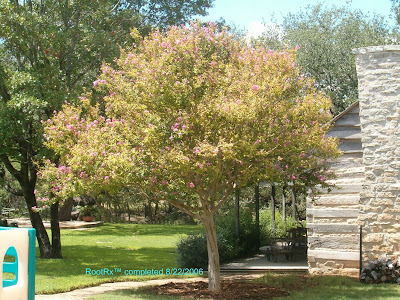
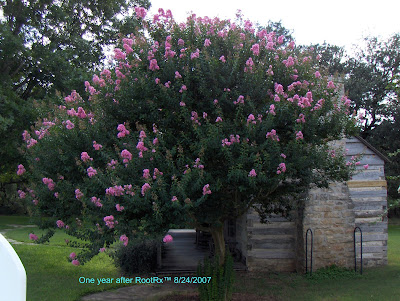
A: Root Invigoration™ (Root Rx™, soil reconditioning) is a procedure for dramatically improving the soil structure and organic content in the root zone of a tree or woody plant, and consequently stimulating fibrous feeder root growth. This strikes at the heart of the principle of "going organic from the ground up"(Hendrickson).
The procedure is described in US Patent #6845587 as
“A method for improving the rooting soil around a plant by defining an improvement area around the trunk of the plant and utilizing an air excavator to loosen the existing rooting soil in the improvement area, the method also includes treating the existing soil with a treatment to encourage growth of the plant roots in the existing treated soil.”
Root Invigoration was born, like many great inventions, out of frustration. We arborists are always looking at distressed and declining trees that are clearly suffering from poor soil nutrition and severely compacted soil. But how do we alleviate the compaction and increase soil organic content without tearing up the roots?
We can re-pot our house plants, but we can’t re-pot a tree, can we? When we go to plant a vegetable garden, we prep the bed (more on this in another post) by tilling the soil and incorporating compost into the parent soil. But if we till the root zone of a tree, then we’ll do more harm than good by tearing up the vast network of surface roots. We could top-dress, but that surface-applied organic matter really only serves to benefit the turf grass and not the tree. We could apply mulch, but how long is it before that decomposing organic matter becomes incorporated into the compacted soil below to any meaningful degree?
Enter the air excavator. Supersonic air tools like the Air Spade® and the Air Knife® have been around for years. Originally developed in the utility industry as a means of reducing the risk of damage to underground pipes (Nathenson & Jarabak, TCI Magazine, May 2001), air excavators are used in arboriculture for the purpose of excavating buried root collars and exposing roots for surgical work.
So, here we have this problem of poor cultural conditions, and we have this air excavator that we’re using for an entirely different purpose. This is when innovators like E. Thomas Smiley, PhD, of the R. A. Bartlett Tree Research Laboratory in Charlotte, North Carolina, and Patrick Brewer, BCMA, of Austin, Texas, began to put the air excavator to use to a new purpose. And all the arboricultural world collectively said, “now why didn’t I think of that?”
The results have been astounding. Horticulturists have known for years that improving plant vigor is sometimes a simple matter of improving the cultural conditions. But when we effect a turnaround on a large shade tree, the effects can be quite dramatic.
We haven’t always been able to turn around a tree, however. Sometimes the tree is already too far gone to respond to treatment, and we are compiling field data on species that simply don’t respond under any circumstances. The procedure needs to be done correctly, too. Several years ago I killed a high-dollar Japanese maple by failing to water in the treatment area thoroughly upon completion. But for the most part I don’t recommend the treatment unless I have a pretty good indication that the tree or trees will respond.
The procedure is also a great bed prep, which simply means that we come in and air-till and incorporate organic matter to an entire planting site prior to the installation of the landscape.
I don’t only do this to distressed trees. In fact, as a tree preservationist I would much rather place a healthy tree under my care than one whose problems have already begun to pile up. The procedure is also great for post-transplant establishment and construction damage prevention and mitigation. One of my favorite situations is deck installation. When a deck is built around a tree it is a safe assumption that there will be no access to the root zone for years. What I do is to recondition the soil using the RI technique just prior to the deck being erected. This sets up the tree with plenty of organic matter to sustain its roots for years to come. There is an added benefit to the procedure: the technician performing the procedure can mark places where the posts can be sunk without damaging the roots.
Please feel free to leave a comment or send an email. If you're looking for a TCIA Accredited Houston Tree Service or Certified Arborist, call the company I've worked for since 2002, Bartlett Tree Experts, at 713-692-6371. This is my personal blog--it is not affiliated with Bartlett Tree Experts.

Thursday, August 7, 2008

Q: Why do I need a soil analysis?

Q: Why do I need a soil analysis?
A: Actually I don't get that question as often as one might think. To most people it makes perfect sense to have a soil analysis done on a property. A soil analysis answers many questions like: how long has the turf grass been robbing the soil of nutrients? Just how deficient in organic matter is the soil? Are these trees trying to develop roots in construction fill?
It's not that we have no idea what the trees need. Actually we can do a great job fertilizing with Texas Boost®. We have been providing excellent soil nutrition without a soil analysis for years. But after all, we are Bartlett, and we do like to take a scientific approach to things. It’s simply the most responsible thing to do: base your formulation on the results from that property.
Furthermore, prescription fertilization (based on soil analysis) is legislation or pending legislation in several states, and it may one day be the law where we live.
Then there’s Liebig’s Law of the Minimum. That agricultural principle states that as long as one nutrient is deficient, then the application of any of the others will do no good. There are plenty of us who may argue that principle until the sun goes down, but it illustrates the efficacy of finding out nutrient levels. The soil analysis helps strike that balance.
I don’t always get a soil analysis. Sometimes I see a tree putting forth an immense effort to push out a flush of foliage following a severe stress event, and I feel the timing is critical to give it a little nudge. In that case I don’t want to wait for lab results.
Here’s an example. A neighbor’s water softener burst and concentrated salt water ran down the driveway to the neighbor’s yard—or so the story goes. Within two days there were massive scorch symptoms on multiple species: pittosporum, turf grass, Asiatic jasmine and one beautiful Texas red oak. A week after the event I was called out, and by this time the red oak had some tiny emerging foliage on it. In that case I fertilized immediately and did not wait for lab results on the soil analysis. (I don’t mean to be disingenuous and credit the fertilizer, by the way. Fertilization was one small part of what we did to try to help stabilize the tree. The tree looks great right now, and bounced back very quickly, more quickly than I think it would have without the TLC we gave it. It could be that we increased its watering regime to try to flush out the salt, it could be that we fertilized, or it could be that it was going to be fine anyway.)
     Please feel free to leave a comment or send an email. If you're looking for a TCIA Accredited Houston Tree Service or Certified Arborist, call the company I've worked for since 2002, Bartlett Tree Experts, at 713-692-6371. This is my personal blog--it is not affiliated with Bartlett Tree Experts.

Tuesday, August 5, 2008

Q: Why is there no mention of ball moss in your pruning specs?

A: You may wonder why ball moss removal is not mentioned in my pruning specifications. The short answer is this: in practical terms, it is impossible to remove all the ball moss without unintentionally removing some live foliage. And nothing is more important than keeping the live foliage intact. I don't mean clipping a little twig here and a little tuft there. I mean large percentages of the tree's leaf population, 30%, 50% even 70% are removed from the tree during a "demossing" operation. Here's what I suggest: don't look up, look down. At the end of the day, when the "highly experienced" tree trimmers have finished "demossing" your trees, take a look at the carpet of dense foliage on the ground. Now look up and ask yourself, is the tree really better off with all that foliage removed?
Let's just say that we've established that ball moss does not hurt the trees. But we do get tired of looking at it. I agree: a big live oak, heavily laden with ball moss, looks awful. Well, allow me to direct your attention, not to the ball moss, but to the foliage. As we look at the tree we begin to see that the canopy is thin and sparse. It has an inordinate amount of dead wood. Then we begin to realize that the real reason the tree looks terrible is not because of the ball moss, but because the tree has a severely compromised leaf population. Let me repeat that. The real reason the tree looks poorly is not because of the ball moss, but because of the poor leaf population!
In fact, I have never seen a live oak that was at 80%, 90% or even 100% of its maximum leaf population potential, and said, boy, that tree sure has a lot of ball moss. In fact, it seems that the healthiest trees we see in our neighborhoods have thicker, denser, darker foliage, less dead wood, and we almost never even notice the moderate amounts of ball moss in them.
I often think that if we needed a hand lens or macroscope to see the ball moss, then we wouldn't be as inclined to blame it for our tree problems. But we can see it a block away, and therefore we blame our tree problems on it. What about oak mites? Eriophyid mites? Leaf diseases? Poor soil organic content? Fact is, there are a host of reasons your tree looks poorly, and ball moss isn't even on the list!
My job is to help you be a better steward to your trees and to your landscapes. Part of that job means making sure you don't waste your limited tree and landscape maintenance dollars on unnecessary work. So, rather than waste your money paying my highly-skilled tree climbers to pick out ball moss, let's prune the trees right, and move on to some commonsense plant health care measures that may actually serve to help improve the leaf population.
Please feel free to leave a comment or send an email. If you're looking for a TCIA Accredited Houston Tree Service or Certified Arborist, call the company I've worked for since 2002, Bartlett Tree Experts, at 713-692-6371. This is my personal blog--it is not affiliated with Bartlett Tree Experts.

Before Pictures


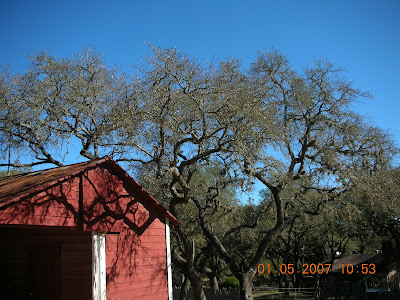
These Texas live oaks were approximately 90% defoliated when this picture was taken in January of 2007. January is a time of year when we assume that our live oaks are supposed to look horrible. In my next post, you will see how a live oak will respond to a little TLC. This is outside of Helotes. In the case of these trees (which I frankly thought were a lost cause), we see that a little organic matter goes a long way. Correction: a lot of organic matter. The principle is simple: Improve the growing medium and the simple economic principle of supply and demand will take over. Result: better leaf population, better leaf health, less premature defoliation.
Please feel free to leave a comment or send an email. If you're looking for a TCIA Accredited Houston Tree Service or Certified Arborist, call the company I've worked for since 2002, Bartlett Tree Experts, at 713-692-6371. This is my personal blog--it is not affiliated with Bartlett Tree Experts.